 My Chart Patient Portal
 Emergency Care
 Urgent Care
 Language Services
 Medical Records
 News & Events
 Charitable Giving
 Programs & Classes
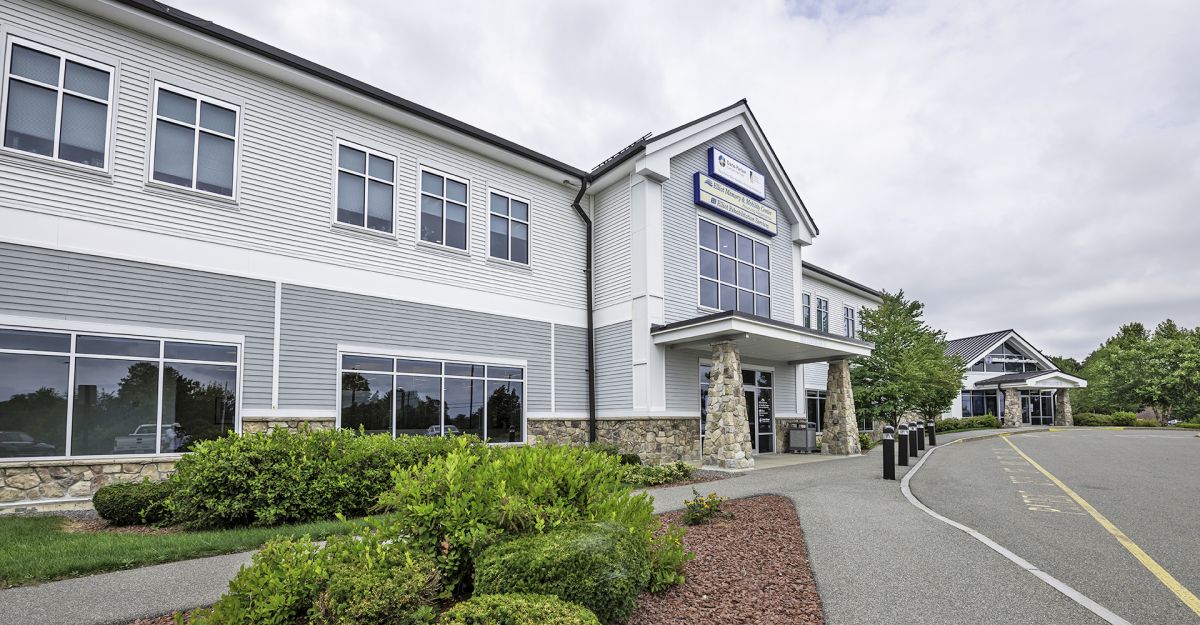
The Elliot at Londonderry
40 Buttrick Road
Londonderry, NH 03053
Phone: 603-669-5300
Hours vary by service

40 Buttrick Road
Londonderry, NH 03053
Phone: 603-669-5300
Hours vary by service
For your safety and convenience, we are strongly urging you to schedule your appointment online for one of our open Urgent Care locations – River’s Edge, Bedford, or Londonderry. This will help facilitate a COVID pre-screen and pre-registration via the telephone. Once your appointment is booked online, a nurse will then call you and can help get you registered.
Walk-ins are invited to complete a screening questionnaire, a nurse will then review it and assist you with making an appointment. You will receive a text message 10 minutes before your appointment to enter the building. In this way we can minimize your risk of exposure and get you from the door to your exam room seamlessly. Those without transportation will be asked to be seated by the nurse in the lobby or waiting room maintaining social distance until their appointed time.
Welcome to the Elliot Medical Center at Londonderry, providing high quality medical care in an environment that is welcoming, sophisticated, unique and easily accessible. The Elliot Medical Center at Londonderry is a state-of-the-art facility providing comprehensive services, the latest imaging technology, and links you to the rest of Elliot Health System through our electronic medical record (EMR) system. We remain committed to bringing needed healthcare resources to Londonderry so citizens of southern New Hampshire have comprehensive, quality healthcare close to home. Enjoy the Elliot Medical Center at Londonderry – we built it for you and your family!
At The Elliot we can help you understand your genetic risk for cancer. Services include:
Phone 603-552-1677 | Fax 603-552-1678
Whether you need an MRI, CT scan or a mammogram, the Elliot Imaging Center at Londonderry offers complete diagnostic imaging services featuring today's most advanced technology and highest quality images.
The care team at Elliot Internal Medicine at Londonderry is dedicated to delivering personalized, high quality primary care to older teenagers and adults. Our physicians and office staff work as a team to deliver the personalized care you need to become and stay healthy.
Our team of experts is here to support your laboratory needs.
Londonderry Pediatrics is now part of Elliot Health System’s primary care and pediatric practice network. You and your family can count on receiving the same great care from the same talented team you have come to know and trust – just with a new practice name: Elliot Pediatrics at Londonderry.
Our practice specializes in pediatric care, from birth to after college, providing evidence-based medical care in a compassionate caring manner.
Elliot Primary Care at Londonderry, a department of Elliot Hospital, is a primary care physician office specializing in family practice, internal medicine, and pediatrics. We offer convenient office hours in the early morning and evening, board-certified family practitioners, internists, and pediatricians, and we accept most types of insurance.
As a department of the Elliot Health System, Elliot Rehabilitation Services has a dedicated team of therapists focused on offering you the very best patient care at convenient locations throughout the Greater Manchester and southern New Hampshire area.
Sometimes, injuries and illnesses are serious enough to require a trip to the emergency department, but for life’s little health problems, the Elliot Urgent Care is a better choice. From late night ear infections to broken bones and everything in between, our specially trained board-certified emergency physicians and staff provide quality and timely treatment. We focus solely on non-life-threatening illnesses and injuries, enabling us to treat you in less time than a traditional hospital emergency department. Elliot Urgent Care features a lab with many test results available in just minutes. Even X-rays and CT scans can be conducted onsite with a professional radiologist’s interpretation during your visit.
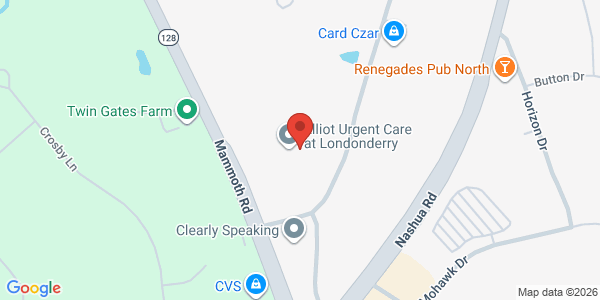
40 Buttrick Road
Londonderry, NH 03053
Our facilities are accessible to all patients. If you require help, please let our staff know in advance.
Ample parking is available outside of the building with easy access to the facility.
For questions about services and practices located at The Elliot at Londonderry, please reach out for assistance.