
 My Chart Patient Portal
 Emergency Care
 Urgent Care
 Language Services
 Medical Records
 News & Events
 Charitable Giving
 Programs & Classes
Published: March 26, 2026
Meet Our Music Therapist: A Q&A With Emily Todd, MT‑BC
If your child is facing a test, procedure, or overnight stay, music therapy can make the hospital feel less scary and more manageable. At Elliot Hospital, a board‑certified music therapist uses live, purposeful music to reduce anxiety, support coping, and create calmer moments, often right at the bedside.
For Child Life and Music Therapy Month, we spoke with Emily Todd, MT‑BC, to answer real parent questions: how sessions work, when they’re used, and the difference music can make on a child’s health.
Q: What inspired you to pursue music therapy?
I started playing music in high school and knew I wanted a career in it, but I wasn’t sure about performing or teaching. One day, my high school orchestra teacher had a former student come talk to our class about music therapy and what she was doing as an intern. That sparked something in me — the idea that I could use music to help people. That’s when I knew this was the path I wanted to take for a career.
Q: What kind of training does a music therapist need?
Music therapists have to go to school specifically for music therapy — a four‑year program with music therapy as the major. During that time, you have music performance classes on your primary instrument, you learn music theory and auditory theory, that you must pass with certain proficiencies. In addition, you take music‑therapy–specific classes, plus psychology and development classes, so you have a foundation for how the body and brain work and how music ties into those things.
After graduating from a four‑year program, you do a six‑month, generally full‑time internship. Then you sit for your board exam, and if you pass, you can practice as an MT‑BC (Music Therapist–Board Certified).
All told, it’s about 2,400 hours of clinical experience before becoming board certified. Many people don’t realize how scientific and research-driven music therapy is. Every technique is purposeful.
Q: How do you explain music therapy to families who are new to it?
I tell families that my job is to help provide comfort to your child while they’re in the hospital. This can mean different things depending on the situation:
- For procedure support: I use music to help distract them from what may be perceived as a scary environment and to help keep them relaxed while in the hospital.
- For movement and play: I’ll introduce specific instruments to help your child get moving or to engage them in therapeutic play.
- For infants: I focus on comfort getting them into a good deep sleep or providing gentle stimulation that won’t stress them out, so they can have a positive sensory experience.
Q: What makes music such a powerful tool for healing?
I personally believe music is a great tool because it’s so accessible. As human beings, music is a deep, ingrained part of our experience. Right from the beginning of life, it’s instinctual to sing to babies because we can feel that’s how we bond and relate. Science is unraveling why we sing and make music, but what we can tangibly know is that music is accessible and relatable to all people. It can transcend differences and misunderstandings and reach people — even when they’re nervous.
Q: Why is music therapy especially important in the NICU?
Preterm babies are some of the most fragile populations we work with. Here at Elliot Hospital, we are able to care for babies born as early as 22 weeks in our Neonatal Intensive Care Unit (NICU) and as the only NICU-certified music therapist working in New Hampshire, I can use music to help infants better adjust to the world around them and reach those key developmental experiences they may have missed out on in the womb.
Music therapy helps support:
- Nervous system regulation
- Bonding with parents
- Improved sleep
- Reduced stress responses
- Familiarity through parental voices
Babies recognize music and voices heard in utero, which makes music a powerful developmental support tool.
Q: What kind of music do NICU babies respond to best?
In the NICU, I use really simple melodies, like children’s songs with consistent elements, especially in Western music. Those patterns are easily recognized and learned. The simpler the music, the better their developing brains can process it.
I also prioritize the family’s culture. Studies show infants respond best to music that the family has been introducing to the baby as early as 28 weeks and prefer that music at birth. They also tend to prefer their mother’s voice, so using specific voices helps mom and baby bond.
Q: Do you perform live music, or use recordings? What instruments do you use?
In the NICU, I tend to use voice only. Sometimes I bring in an acoustic guitar, but you want the least amount of stimulation. One thing I’m hoping to introduce within the next year is bringing parent voices in where we can have speakers at bedside, and parents can record their voice on an app so it can be played for the infant. I’m excited about the possibility of incorporating more recorded parent sounds.
In the pediatric population, I do a lot of music‑making. We partner with Ukulele Kids Club — ukulele is my instrument of choice, and I almost always have it with me. A big goal of mine is getting patients involved in the music themselves. I have a cart with maracas, a little drum, and a small xylophone that’s easy for young kids to play. For older school‑age children, I might bring a keyboard so we can play or do a ukulele lesson.
I also have instruments specifically for relaxation such as a tongue drum pitched so you can’t play wrong notes, and a reverie harp that sits in your lap. It has an oblong, ‘Easter egg’ shape and pleasant sound no matter who plays it, so kids can close their eyes and listen or play it themselves.
Q: What’s something surprising that people often don’t realize about music therapy?
I think most people are surprised there’s a science behind it, that what I’m doing is purposeful. I’m not just playing to play or saying, ‘music is nice, so I’ll play music.’ Music therapy is purpose‑driven. That differentiates music from music therapy — everything I do has rationale. It can look like play and fun, but there’s an intention behind it.
Q: What do you find most meaningful or rewarding about your work?
The ability to have an impact on my community is a big draw for me. A lot of people aren’t expecting music in the hospital, but when they encounter it, it makes a huge difference. My hope is it changes how people perceive their health care—we're here to take care of our community—and I hope bringing music into it changes their experience and the way they feel about their experience here.
Every child deserves comfort and support during their hospital stay, and you can help make that possible.
Gifts to our Child Life Program directly impact families by enhancing services like music therapy, therapeutic play, and coping support.
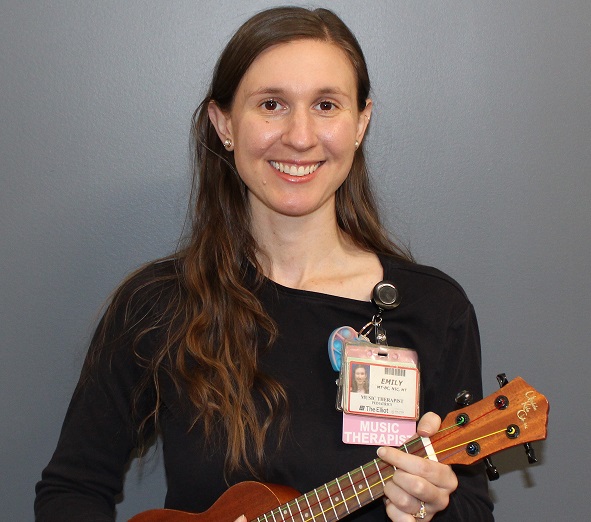 Emily Todd, MT‑BC, is Elliot Hospital’s board‑certified music therapist with a passion for using music to support healing. Emily provides evidence‑based, live music therapy to infants, children, and families across our NICU and pediatric units. She specializes in using simple, soothing melodies to promote comfort, reduce anxiety, and support developmental needs at the bedside. Emily is dedicated to helping families feel more at ease during hospital stays.